NDM
INFORMATIONAL REPORT
CCSDS 500.2-G-3
GREEN BOOK
March 2023
FOREWORD
This CCSDS report, Navigation Data Messages Overview, contains background and explanatory material to supplement the CCSDS Recommended Standards for spacecraft navigation data. The document presents the conceptual framework and rationale for the exchange of navigation data, the definitions and conventions associated with inter-Agency cross-support situations involving the transfer of navigation data, as well as current and envisioned CCSDS Navigation Data Messages.
Through the process of normal evolution, it is expected that expansion, deletion, or modification of this document may occur. This Report is therefore subject to CCSDS document management and change control procedures, which are defined in Organization and Processes for the Consultative Committee for Space Data Systems (CCSDS A02.1-Y-4). Current versions of CCSDS documents are maintained at the CCSDS Web site:
Questions relating to the contents or status of this document should be sent to the CCSDS Secretariat at the email address indicated on page i.
At time of publication, the active Member and Observer Agencies of the CCSDS were:
Member Agencies
Agenzia Spaziale Italiana (ASI)/Italy.
Canadian Space Agency (CSA)/Canada.
Centre National d’Etudes Spatiales (CNES)/France.
China National Space Administration (CNSA)/People’s Republic of China.
Deutsches Zentrum für Luft- und Raumfahrt (DLR)/Germany.
European Space Agency (ESA)/Europe.
Federal Space Agency (FSA)/Russian Federation.
Instituto Nacional de Pesquisas Espaciais (INPE)/Brazil.
Japan Aerospace Exploration Agency (JAXA)/Japan.
National Aeronautics and Space Administration (NASA)/USA.
UK Space Agency/United Kingdom.
Observer Agencies
Austrian Space Agency (ASA)/Austria.
Belgian Science Policy Office (BELSPO)/Belgium.
Central Research Institute of Machine Building (TsNIIMash)/Russian Federation.
China Satellite Launch and Tracking Control General, Beijing Institute of Tracking and Telecommunications Technology (CLTC/BITTT)/China.
Chinese Academy of Sciences (CAS)/China.
China Academy of Space Technology (CAST)/China.
Commonwealth Scientific and Industrial Research Organization (CSIRO)/Australia.
Danish National Space Center (DNSC)/Denmark.
Departamento de Ciência e Tecnologia Aeroespacial (DCTA)/Brazil.
Electronics and Telecommunications Research Institute (ETRI)/Korea.
European Organization for the Exploitation of Meteorological Satellites (EUMETSAT)/Europe.
European Telecommunications Satellite Organization (EUTELSAT)/Europe.
Geo-Informatics and Space Technology Development Agency (GISTDA)/Thailand.
Hellenic National Space Committee (HNSC)/Greece.
Hellenic Space Agency (HSA)/Greece.
Indian Space Research Organization (ISRO)/India.
Institute of Space Research (IKI)/Russian Federation.
Korea Aerospace Research Institute (KARI)/Korea.
Ministry of Communications (MOC)/Israel.
Mohammed Bin Rashid Space Centre (MBRSC)/United Arab Emirates.
National Institute of Information and Communications Technology (NICT)/Japan.
National Oceanic and Atmospheric Administration (NOAA)/USA.
National Space Agency of the Republic of Kazakhstan (NSARK)/Kazakhstan.
National Space Organization (NSPO)/Chinese Taipei.
Naval Center for Space Technology (NCST)/USA.
Netherlands Space Office (NSO)/The Netherlands.
Research Institute for Particle & Nuclear Physics (KFKI)/Hungary.
Scientific and Technological Research Council of Turkey (TUBITAK)/Turkey.
South African National Space Agency (SANSA)/Republic of South Africa.
Space and Upper Atmosphere Research Commission (SUPARCO)/Pakistan.
Swedish Space Corporation (SSC)/Sweden.
Swiss Space Office (SSO)/Switzerland.
United States Geological Survey (USGS)/USA.
DOCUMENT CONTROL
Document |
Title |
Date |
Status |
|---|---|---|---|
CCSDS 500.2-G-1 |
Navigation Data Messages Overview, Informational Report, Issue 1 |
December 2015 |
Original issue, superseded |
CCSDS 500.2-G-2 |
Navigation Data Messages Overview, Informational Report, Issue 2 |
April 2020 |
Issue 2, superseded |
CCSDS 500.2-G-3 |
Navigation Data Messages Overview, Informational Report, Issue 3 |
March 2023 |
Current issue |
1 INTRODUCTION
1.1 PURPOSE AND SCOPE
Spacecraft navigation data is exchanged during cross support of space missions. The purpose of this document is to establish a common understanding for the exchange of spacecraft navigation data. This exchange is facilitated through the use of the various navigation data messages defined in section 4. This document presents the general definitions and terms of spacecraft navigation and flight dynamics, the conceptual framework and rationale for the exchange of navigation data, the definitions and conventions associated with interagency cross-support situations involving the transfer of navigation data, as well as current and envisioned CCSDS Navigation Data Messages. [17] deals explicitly with the technical definitions and conventions used widely to describe the properties, measurements, and ancillary information of spacecraft dynamics required for navigation. [17] is a registry of technical definitions of navigation standard time systems, coordinate frames, and element sets.
For the purposes of this document, orbit, attitude, maneuver, tracking data, conjunction assessment information, pointing, and re-entry data are considered integral parts of the spacecraft navigation process.
Types of navigation data exchanged and discussed in both this document and [17] include:
orbit data in the form of orbit elements or position and velocity of a spacecraft in Cartesian coordinates;
attitude data for either a spinning or three-axis stabilized spacecraft;
tracking data and network system information;
conjunction assessment data;
environmental models;
properties and measurements of spacecraft dynamics;
ancillary data required for the proper interpretation of properties and measurements within spacecraft navigation.
1.2 APPLICABILITY
This document serves as a guideline for the development and usage of international standards for the exchange of spacecraft navigation data.
1.3 STRUCTURE OF THIS DOCUMENT
Section 1 (this section) provides an introduction including the document’s purpose and scope, applicability, structure, and references.
Section 2 provides a brief overview of the spacecraft navigation processes as well as the definition of key terms relevant to this process.
Section 3 provides foundational information regarding the navigation data message exchange architecture.
Section 4 provides an overview of the CCSDS Navigation Data Messages (NDMs), and introduces the current recommended and envisioned CCSDS standards for the exchange of navigation data.
Annex A provides a listing of abbreviations and acronyms.
1.4 REFERENCES
The following publications are referenced in this document. At the time of publication, the editions indicated were valid. All publications are subject to revision, and users of this document are encouraged to investigate the possibility of applying the most recent editions of the publications indicated below. The CCSDS Secretariat maintains a register of currently valid CCSDS publications.
- [6]
Attitude Data Messages. Issue 2. Recommendation for Space Data System Standards (Blue Book), CCSDS 504.0-B-2. Washington, D.C.: CCSDS, forthcoming.
- [7]
Orbit Data Messages. Issue 3. Recommendation for Space Data System Standards (Blue Book), CCSDS 502.0-B-3. Washington, D.C.: CCSDS, forthcoming.
- [8]
Tracking Data Message. Issue 2. Recommendation for Space Data System Standards (Blue Book), CCSDS 503.0-B-2. Washington, D.C.: CCSDS, June 2020.
- [9]
Time Code Formats. Issue 4. Recommendation for Space Data System Standards (Blue Book), CCSDS 301.0-B-4. Washington, D.C.: CCSDS, November 2010.
- [10]
David A. Vallado, et al. “Revisiting Spacetrack Report #3.” In Proceedings of the AIAA/AAS Astrodynamics Specialist Conference and Exhibit. AIAA 2006-6753. Reston, Virginia: AIAA, 2006.
- [11]
XML Specification for Navigation Data Messages. Issue 3. Recommendation for Space Data System Standards (Blue Book), CCSDS 505.0-B-3. Washington, D.C.: CCSDS, forthcoming.
- [13]
Conjunction Data Message. Issue 1. Recommendation for Space Data System Standards (Blue Book), CCSDS 508.0-B-1. Washington, D.C.: CCSDS, June 2013.
- [14]
Pointing Request Message. Issue 1. Recommendation for Space Data System Standards (Blue Book), CCSDS 509.0-B-1. Washington, D.C.: CCSDS, February 2018.
- [15]
Re-entry Data Message. Issue 1. Recommendation for Space Data System Standards (Blue Book), CCSDS 508.1-B-1. Washington, D.C.: CCSDS, November 2019.
- [16]
Navigation Events Message. Under development.
- [18]
“CCSDS Navigation Standards Normative Annexes.” Space Assigned Numbers Authority. https://sanaregistry.org/r/navigation_standard_normative_annexes.
- [19]
“Navigation Data Messages XML Schema.” Space Assigned Numbers Authority (SANA). https://sanaregistry.org/r/ndmxml.
- [20]
“Publications.” The Consultative Committee for Space Data Systems. https://public.ccsds.org/Publications/default.aspx.
- [21]
Cross Support Transfer Service—Tracking Data Service. Issue 2. Recommendation for Space Data System Standards (Blue Book), CCSDS 922.2-B-2. Washington, D.C.: CCSDS, February 2023.
- [22]
Fragmentation Data Message. Under development.
2 SCOPE OF NAVIGATION
2.1 OVERVIEW
This section briefly describes the spacecraft navigation process and defines terms relevant to this process.
2.2 NAVIGATION
2.2.1 DEFINITION
The word ‘navigate’ is derived from the Latin words navis, meaning ship, and agere, meaning to move or direct. The common definition of navigation establishes that it is the science of getting any object, a craft or person, from one place or orientation to another. In this document, navigation is the determination and prediction of the spacecraft orbit and attitude, which are specified by their translational and rotational motion, respectively.
2.2.2 SPACECRAFT NAVIGATION TERMS AND DEFINITIONS
In order to establish a solid standard for the exchange of spacecraft navigation data among agencies, it is important that terms relevant to this process be clearly defined. These terms are as follows:
- property
An attribute or characteristic of an object or concept. In the context of this document, properties represent the physical attributes of the spacecraft, rovers, equipment, tracking stations, and relevant environment needed for navigation.
- measurement
Quantitative data collected by an instrument specifically to improve the knowledge of properties. In the context of this document, measurements are quantities obtained from devices such as radio receivers, attitude sensors, and so on.
Note
Any piece of information can be treated as a property or a measurement; the distinction is in how the information is used.
- ancillary information
Any data type needed to correctly interpret properties and measurements. In general, ancillary information makes it possible to take properties or measurements and incorporate them correctly into numerical computations.
- navigation data
A set of measurements, properties, and ancillary information related to navigation.
- navigation data message
A particular arrangement of the navigation data whose structure and content are the subjects of CCSDS Recommended Standards as developed by the CCSDS Navigation Working Group.
- participant
An entity that has the ability to acquire or broadcast navigation data. Possible participants can be arranged into three categories, as depicted in figure 2-1.
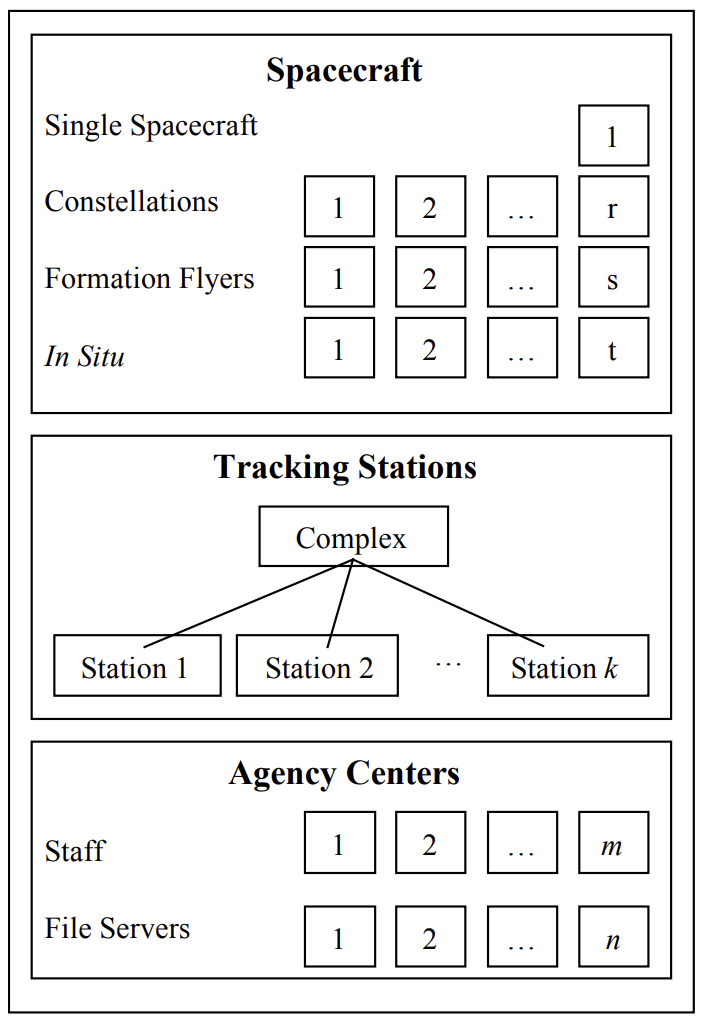
Figure 2-1: Participant Categories
- spacecraft
Participant type consisting of a single vehicle orbiting a celestial body or point, or as part of a set, such as constellations or formations. The term ‘spacecraft’ also includes assets in operations at, or in close proximity to, a remote body. These types of participants are referred to as in situ assets, and consist of rovers, landers, aircraft, and so on. Navigation data are exchanged to/from these participants and are usually optimized in response to bandwidth, power, or message format constraints.
- ground stations and space networks
Participant types that enable spacecraft tracking and communications between the spacecraft and ground. Communications with the spacecraft are made possible by either a network of fixed ground stations located around the world, or a network of space-borne assets with a ground-based terminal. Some spacecraft are equipped with the necessary navigation software and/or hardware to do onboard orbit determination and control with data from space networks or communication links. Ground-based facilities that provide tracking capabilities are used to monitor the location of a spacecraft. Whenever an orbiting spacecraft passes across the field of view of a ground station, it is possible to collect tracking data that will be used for determining the spacecraft position and velocity. Some agencies have multiple stations operated by a central entity, referred to as a complex. Similarly, multiple space-borne assets in a network operated by a central entity are referred to as a fleet.
- agency center
Participant type that includes the facilities used for the uplink of commands or software loads to the spacecraft, as well as for spacecraft telemetry monitoring, tracking, flight dynamics, and other engineering activities. Navigation data may be exchanged between agency centers by operations staff (e.g., via email or FTP) or by servers across a computer network common to both the broadcasting and acquiring agents.
- navigation session
The interchange of navigation data messages between participants.
- orbit
The translational motion of a spacecraft around a larger central body, resulting from gravity forces of the larger mass acting on the spacecraft. The orbit of a spacecraft is the trajectory that does not, in the absence of perturbations, intersect with the central body. This trajectory is the path of the small mass, or spacecraft, orbiting the central body through space. The orbit can be represented as position and velocity in a state vector, or as orbital elements as defined in references [17] and [12]. There are other types of orbits that are affected by the gravity pull of two larger masses, for example, the Moon and Earth, such that the spacecraft with an appropriate velocity will remain in the same position relative to the two larger bodies. These orbits are called Lagrange or libration point orbits.
- attitude
The orientation and/or pointing of a spacecraft, defined by its rotation relative to a defined reference coordinate system. The preferred attitude representation depends on the stabilization mode of the spacecraft. For instance, a spin-stabilized spacecraft can best be represented by the attitude of a single axis either as a three-component unit vector or as a point on the unit celestial sphere. This representation sometimes includes the phase of rotation about that axis. For three-axis stabilized spacecraft, the attitude can best be represented by a coordinate transformation from reference axes in inertial space to the spacecraft body frame. (See references [17] and [3] for available attitude representations.)
- orbital dynamics
The study of the changes in the position of all orbiting bodies. In contrast, attitude dynamics deals with the changes in the orientation and pointing of the spacecraft.
- flight dynamics
A term used to cover both orbital and attitude dynamics. It refers to the study of translational and rotational motion and control of a flying object, whether it is an aircraft or spacecraft. Within the aerospace industry, the flight dynamics term could be used for mission design and analysis as well as the support required for determining, controlling, and maintaining the orbit and attitude of a spacecraft.
- orbit determination and attitude determination
The processes within navigation to find the present and past positions and orientations of a spacecraft. These two navigation processes fit a set of measurements to a physical model in some optimal way to obtain the best orbit and attitude solutions. Although they are related, these processes affect each other only weakly so they can generally be performed separately. For example, a nominal or representative attitude can generally be used in drag models that affect orbit determination, and a predetermined ephemeris can generally be used in attitude determination. The results of these two processes can also be used to predict future positions and orientations of the spacecraft.
- guidance
The process of defining a path to move a spacecraft from one point to another or from one orientation to another.
- control
The process to maintain a spacecraft within the prescribed path and attitude.
The above terms guidance, navigation, and control are commonly grouped together and abbreviated GN&C. The term GN&C is used to describe a system or subsystem forming part of a spacecraft or aircraft. The GN&C system includes all the hardware (sensors and actuators) and software necessary for both onboard or ground-based orbit and attitude determination and control.
The Attitude Control System (ACS), or alternatively, the Attitude Determination and Control System (ADCS), is part of GN&C and consists specifically of hardware and software for onboard attitude estimation and pointing control. The propulsion system is an essential element of GN&C and a complement for ACS within a spacecraft for attitude and/or orbit thruster control.
The discussion of guidance and control is outside of the scope of this Report.
2.2.3 SPACECRAFT NAVIGATION PROCESSES
In addition to orbit and attitude determination introduced in 2.2.2, maneuver planning and reconstruction for orbit and attitude control, conjunction assessment and collision risk analysis, and calibration of hardware used for navigation are also important processes. In general estimation terms, all of these spacecraft navigation processes can take place either in real time, near-real time, or after the fact (also referred to as reconstruction), as illustrated in figure 2-2.
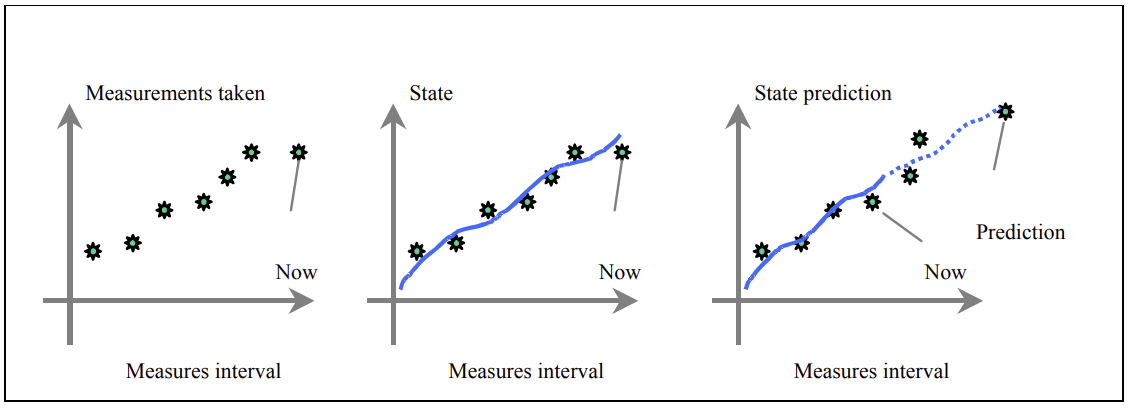
Figure 2-2: Navigation Estimation Process
Examples of the navigation data exchanged during orbit and attitude determination processes include tracking measurements or observations, orbit parameters, planned or conducted maneuvers, attitude parameters, and an ephemeris as described in section 4. These determination processes produce single orbit and attitude parameter or history solutions by fitting hardware measurements to a physical model. This physical model represents the relationship between the measurements and the desired solution (position, velocity, attitude, etc.). Often additional model parameters that affect the solution are also solved for to improve the navigation solution. Examples of such parameters are drag coefficients or gyro biases. The set of all parameters that is solved for is called the state of the system.
The more parameters in the state, and the more complex the model, the more data is needed to find a solution. Once a model with the dynamics is defined, data at different times may be used, so there is generally more data available than the minimum needed to find a unique solution. In such ‘over determined’ cases, especially when the observations are uncertain, least-squares or other estimation techniques are used to find the best state to match the observations to the model.
For example, if one knows the position of a spacecraft, it is easy to compute the distance from the spacecraft to known points. The reverse process, computing the position of the spacecraft from a single distance measurement, does not give a unique solution. To obtain a unique solution, distances from several known points at one time are needed. Alternatively, distances from a known point at different times or different types of data (e.g., velocity measurements) can be used. In order to use the time-dependent differences, a model of the change of position of the spacecraft with time must be generated from the principles of physics. This model can be made more accurate by including perturbations in it, such as drag, and solving for parameters that help define the effect of these perturbations on the position as a function of time.
For the most part, the orbit and attitude determination processes can, however, be generalized to the following four steps:
A set of measurements is acquired.
A dynamic model is fit to a set of measurements to provide a solution state (cf. references [2], [3], [4], [5], and [12]), which is found by minimizing the differences between measurements and reference values corresponding to the measurements.
The solution state may be used in the model to predict the future state.
If necessary, the spacecraft state is altered at some future time:
For trajectories/flight paths: A spacecraft propulsive maneuver is performed to correct the trajectory to meet mission requirements and constraints or in the performance of debris avoidance. This process is called ‘flight path control’.
For attitudes: A maneuver is performed to modify the spacecraft attitude to meet mission requirements and constraints. This process is called ‘attitude adjustment’.
3 NAVIGATION DATA MESSAGE EXCHANGE FRAMEWORK
3.1 OVERVIEW
This section describes the elements, characteristics, and major groupings of navigation data message exchanges.
3.2 NAVIGATION DATA AND NAVIGATION DATA MESSAGES
3.2.1 GENERAL
Figure 3-1 describes the roles of navigation data versus navigation data messages.
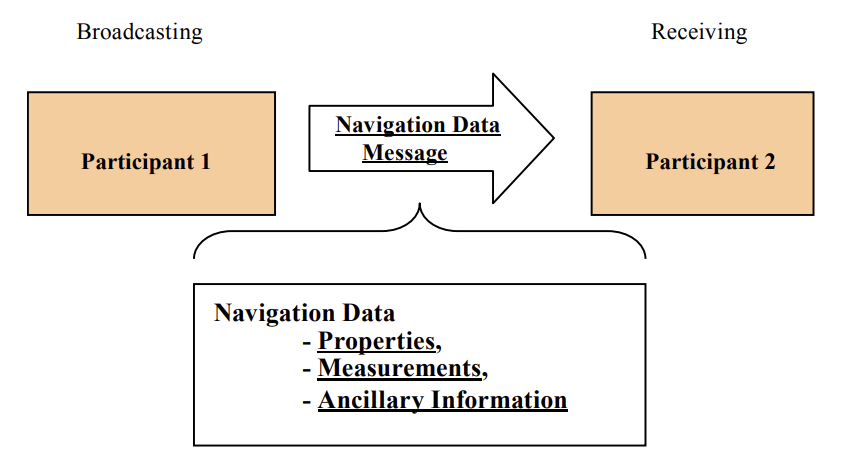
Figure 3-1: Navigation Data Message Exchange Definitions
Ideally, every navigation data message exchange will be covered by a CCSDS Recommended Standard related to flight dynamics. However, the completed CCSDS Recommended Standards cannot presently cover the entire range of exchanges. It should also be noted that spacecraft telemetry downlinked to the ground that contains navigation data is treated using CCSDS standards that are not in the flight dynamics domain. Section 4 introduces the current and proposed Recommended Standards for the exchange of navigation data. Agencies can benefit from utilizing these formats at the present time. The following are the current exchange scenarios within the scope of CCSDS:
Ground-to-ground exchanges are defined as the set of exchanges between two non- spacecraft participants.
Ground-to-flight and flight-to-ground exchanges are defined as the set of exchanges between a spacecraft participant and a non-spacecraft participant.
Flight-to-flight exchanges are defined as the set of exchanges between two spacecraft participants.
3.2.2 NAVIGATION DATA EXCHANGE CHARACTERISTICS
This subsection describes a framework for the exchange of messages between any two types of participants (see 2.2.2 and figure 2-1). It is not possible to describe every potential navigation session in detail, but navigation sessions generally have the following three general characteristics:
Navigation sessions may be divided so as to accommodate constraints on data rates or availability of relevant information. For example, for launch support of a spacecraft, state vectors (see [17] [12] [3]) could be exchanged between operations centers of two agencies. This exchange may be digital or through sharing of an image of the data. The text contains (1) the relevant property information (the position and velocity or attitude of the spacecraft), and (2) all of the necessary ancillary information needed to interpret the position and velocity or attitude of the spacecraft (coordinate frame, time, time system, spacecraft ID, etc.). All of the information needed to unambiguously interpret the property information is sent in one event. In a second example, it may be necessary to send spacecraft position or orientation updates from one spacecraft to another in real time. Because of bandwidth limitations on the telemetry, it may not be desirable to send any other ancillary information at that time. In that case, the participating agencies should agree on the coordinate frames, time frames, and so on, beforehand, and commit these pieces of information to an Interface Control Document (ICD). This document, in fact, becomes part of the overall navigation session as depicted in figure 3-2.
Navigation data messages may utilize a shorthand of a CCSDS Recommended Standard to convey ancillary information. The shorthand developed in each case should be unambiguous, flexible, and extensible. For example, in the case described in part (a) of figure 3-2, the coordinate frame can be an ASCII string, such as ‘Earth Centered True of Date’. It is possible to assign each coordinate frame a unique ASCII string, but there is a loss of extensibility with that approach, and in some cases, the required number of bits of information may be prohibitive. It is also possible to assign a unique ID number to each coordinate frame; this approach would result in a fairly compact message, but the resulting order of coordinate frame IDs would have little physical meaning. (Shorthand conventions for commonly used data types are reviewed in [17].)
The content of a navigation session may be governed by more than one CCSDS Recommended Standard. For example, if one agency is to provide another with the time history of the position of a sensor or antenna on a spacecraft, there are three pieces of information that need to be exchanged, each with its own format: (1) the time history of the spacecraft trajectory or orbit, (2) the position of the sensor or antenna with respect to the spacecraft center of mass (given most likely in a spacecraft fixed frame), and (3) the attitude history of the spacecraft. Although the content of these pieces comes from different Recommended Standards, the information itself can be sent at one time or in separate events (see figure 3-3).
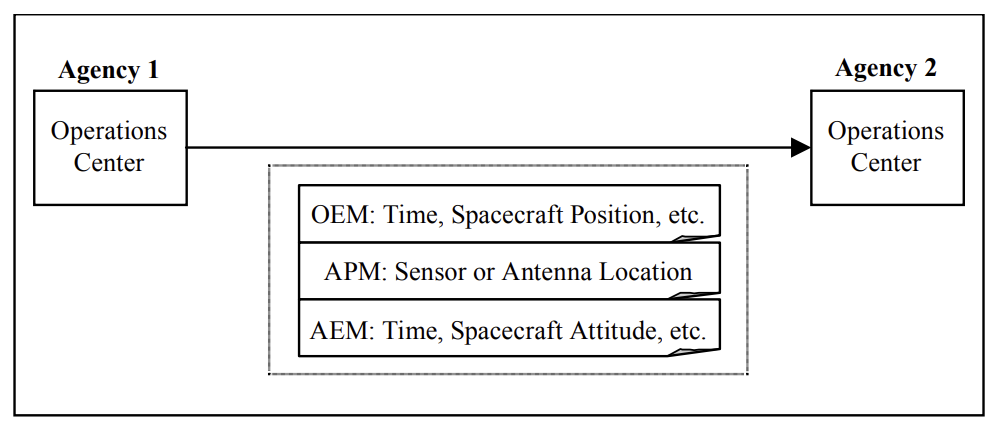
Figure 3-3: Navigation Session Using Multiple CCSDS Recommended Standards
4 CCSDS NAVIGATION DATA MESSAGES
4.1 GENERAL
This section provides an overview of the current and envisioned CCSDS Navigation Data Messages. It also reflects an application of the Navigation Data Message Exchange Framework described in section 3.
The selection of navigation data formats and interfaces necessary for mission-operations support is done very early during the development of the ground system. Standards are highly desirable for the correct interpretation and common understanding of the exchange of navigation data, with the purpose of facilitating communications within an agency and/or between agencies. Because interagency partnering in mission operations is becoming more widespread, standardization of navigation data formats facilitates interoperability between space agencies, where navigation functions for a mission of agency A could be performed by agency B, or vice-versa. In addition, standards for spacecraft navigation data could permit the reuse of software modules that read the input and generate the proper output products within the navigation process. This could facilitate an increased level of automation within the ground system.
There are currently six published standards for the exchange of spacecraft navigation data: Attitude Data Message (ADM), Orbit Data Message (ODM), Tracking Data Message (TDM), Conjunction Data Message (CDM), Pointing Request Message (PRM), and Re-Entry Data Message (RDM). An overview of these standards is provided in the subsequent subsections. The details of the ADM, ODM, TDM, CDM, PRM, and RDM are specified in references [6], [7], [8], [13], [14], and [15], respectively. The published standards are reviewed every five years. The three actions to be considered in the five-year review are ‘reconfirm’, ‘retire’, or ‘revise’, as applicable (see [1]).
There are additional navigation data standards being developed and envisioned to fulfill and facilitate the execution and implementation of other navigation functions. Such standards under development are: Navigation Events Message (NEM, reference [16]) and Fragmentation Data Message (FDM, reference [22]), which will provide a standard framework for the exchange of orbit and attitude events and a standard message format for the exchange of fragmentation information, respectively.
The objective of all navigation data messages is to minimize the burden during the implementation phase by giving a specification and unambiguous interpretation of the input and output data for common navigation processes. Each standard is developed to communicate the necessary data elements in a compact format that is readable to the human eye, as well as readable by computers to enable automation of navigation processes. The NDM standards are only applicable to the message format and content, but not to its transmission. The transmission method or mechanism used by the partners exchanging NDMs is beyond the scope of the standards and should be specified in ICDs. The message transmission could be based on a CCSDS data transfer protocol, file based transfer protocol such as SFTP, stream-oriented media, or other secure transmission mechanism. Once published by the CCSDS, all the CCSDS Navigation Standards are posted and available free of charge at the CCSDS Web site (reference [20]). The following is a brief summary of all NDMs described in 4.2 and 4.2.6:
The TDM contains information that can be used to determine the orbit state of a spacecraft.
The ODM contains information that defines the orbit state of a spacecraft at one or more times.
The ADM contains information that defines the attitude state of a spacecraft or instrument at one or more times.
The CDM contains information that defines the relationship between the orbit states of different space objects at their time of closest approach.
The PRM contains information on the desired attitude state of an object at one or more future times.
The RDM contains information that describes the re-entry event of a space object.
The NEM provides a framework for the exchange of orbit, attitude, and related events.
The remainder of this document provides a more detailed overview of the CCSDS navigation standards that have either been published (see 4.2) or are under development (see 4.2.6).
4.4 NAVIGATION DATA MESSAGES USE CASE EXAMPLES
This subsection provides general examples of NDM use cases as input to and output from navigation processes.
Figure 4-1 below shows a high-level exchange scenario of OEMs and CDMs in an end-to- end CA process. As seen in the figure, two OEMs are used to determine a conjunction, one OEM per object. If there is a high probability of collision, a CDM is generated and provided to the owners and/or operators of the spacecraft. The CDM will then contain all the conjunction information to assess the risk of the collision and design an avoidance maneuver, if necessary. Therefore both OEM and CDM exchanges are essential for CA.
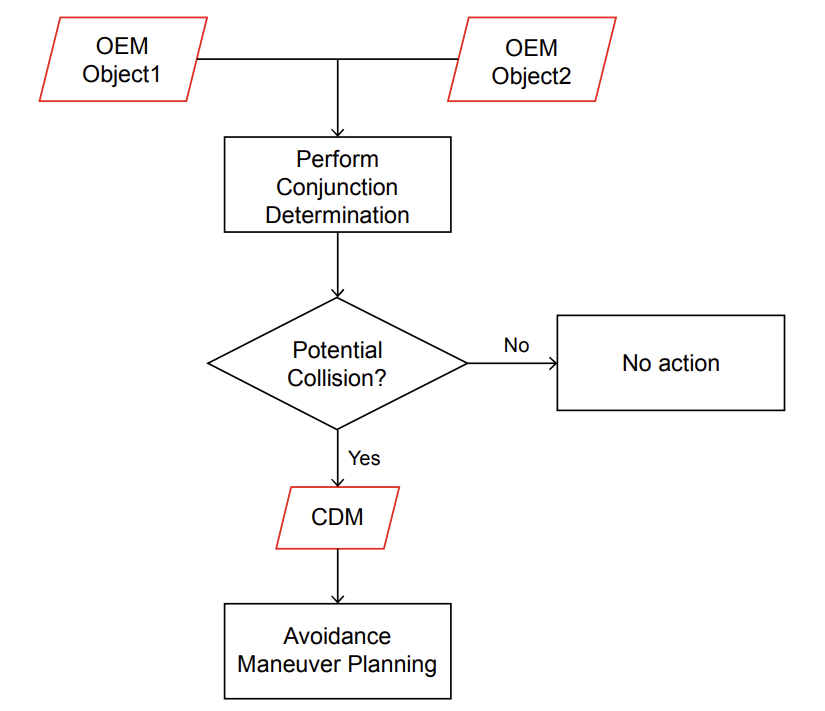
Figure 4-1: Use Case Example
Two other navigation processes that require exchanges of NDMs are orbit and attitude determination (see 2.2.3). Orbit determination can be done either with tracking data from a TDM or orbit related hardware data (e.g., GNSS receiver), while attitude sensor data (e.g., quaternion from star sensor, body rates from IRU, etc.) are necessary for attitude determination. ODMs and ADMs are the spacecraft orbit and attitude state solutions computed during the determination process. Figure 4-2 depicts a diagram of the use of TDMs as input for orbit determination, and ODMs and ADMs as the generated output of these two processes, respectively.
Note
NDMs do not cover the format and/or transfer of spacecraft telemetry containing navigation data being downlinked to the ground. Other CCSDS standards provide the data format and transfer of spacecraft telemetry to the ground.
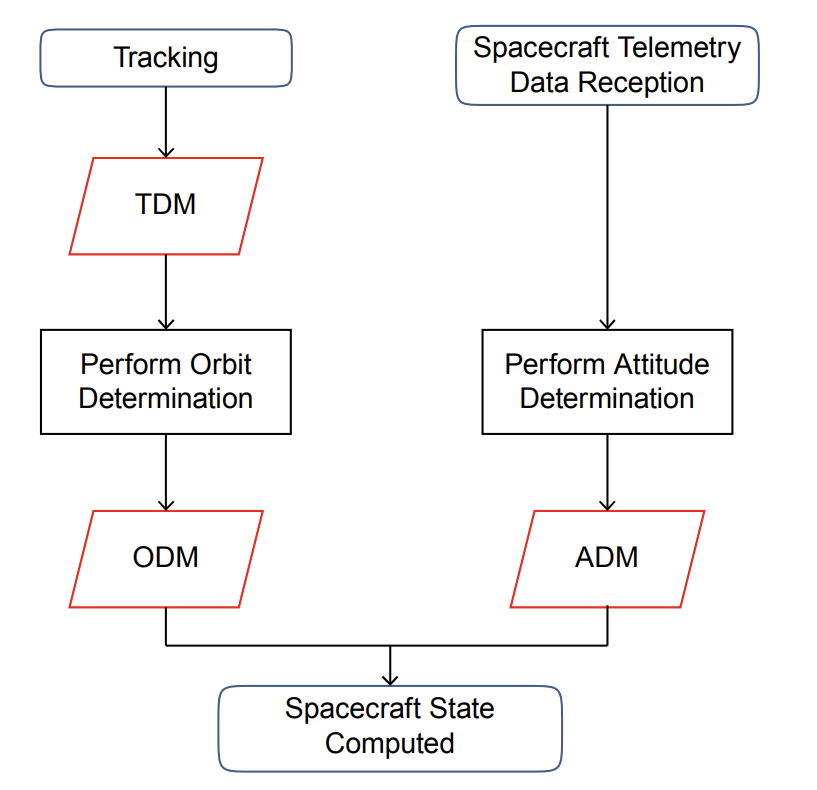
Figure 4-2: TDM, ODM, and ADM Use Case Example
As opposed to the previous use cases, which had to do with message exchanges primarily for attitude and orbit determination processes, as well as conjunction assessment, an exchange of a PRM is the catalyst for spacecraft orbit and attitude maneuver planning, execution, and reconstruction. The PRM may be used to request repointing the spacecraft to a different attitude, and for orientation changes of spacecraft articulated instruments or appendages. As seen in figure 4-3, the PRM is provided with the desired instrument pointing to the team that performs the maneuver planning and execution to achieve the final orientation.
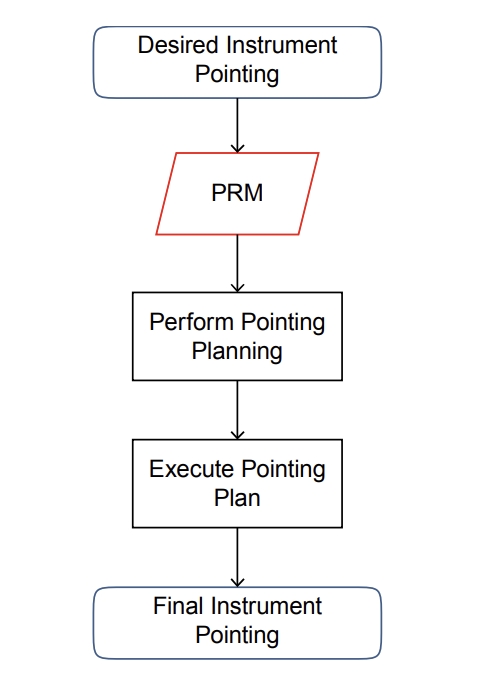
Figure 4-3: PRM Use Case Example
ANNEX A
ABBREVIATIONS AND ACRONYMS
- ACS
attitude control system
- ACM
Attitude Comprehensive Message
- ADCS
attitude determination and control system
- ADM
Attitude Data Message
- AEM
Attitude Ephemeris Message
- AOS
acquisition of signal
- APM
Attitude Parameter Message
- ASCII
American Standard Code for Information Interchange
- CA
Conjunction Assessment
- CARA
Conjunction Assessment Risk Analysis
- CCSDS
Consultative Committee for Space Data Systems
- CDM
Conjunction Data Message
- CNES
Centre National d’Etudes Spatiales
- CSpOC
Combined Space Operations Center
- CSTS
Cross Support Transfer Services
- DLR
Deutsches Zentrum fur Luft-und Raumfahrt
- DOR
differential one-way ranging
- DSN
Deep Space Network
- EFT-1
Exploration Flight Test-1
- ESA
European Space Agency
- ESOC
European Space Operations Centre
- FDM
Fragmentation Data Message
- FTP
File Transfer Protocol
- GN&C
Guidance, Navigation, and Control
- GNSS
Global Navigation Satellite System
- GSFC
Goddard Space Flight Center
- ICD
interface control document
- ID
identification
- IRU
inertial reference unit
- ISRO
Indian Space Research Organization
- ISS
International Space Station
- JAXA
Japan Aerospace Exploration Agency
- JPL
Jet Propulsion Laboratory
- JSC
Johnson Space Center
- KVN
keyword value notation
- LOS
loss of signal
- MMS
Magnetospheric Multiscale Mission
- NASA
National Aeronautics and Space Administration
- NDM
Navigation Data Message
- NEM
Navigation Event Message
- NORAD
North American Aerospace Defense Command
- OCM
Orbit Comprehensive Message
- ODM
Orbit Data Message
- OEM
Orbit Ephemeris Message
- OMM
Orbit Mean-Elements Message
- OPM
Orbit Parameter Message
- POC
probability of collision
- PRM
Pointing Request Message
- RDM
Re-Entry Data Message
- SANA
Space Assigned Numbers Authority
- SFTP
Secure File Transfer Protocol
- SI
International System of Units
- SSA
space situational awareness
- SST
space surveillance and tracking
- TCA
time of closest approach
- TDM
Tracking Data Message
- TDRSS
Tracking and Data Relay Satellite System
- TLE
two-line elements
- UT1
Universal Time
- UTC
Coordinated Universal Time
- WRMS
weighted root-mean square
- XML
Extensible Markup Language